


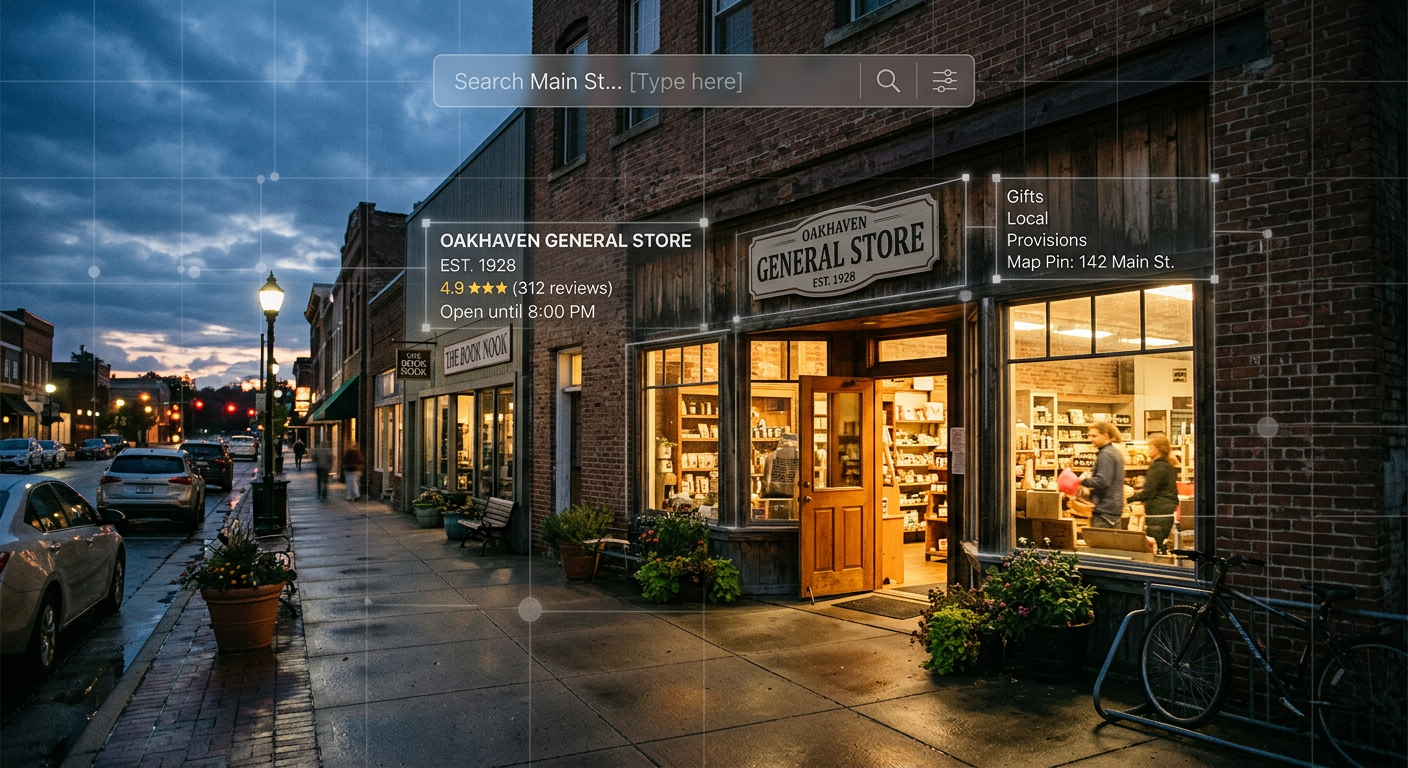
If you’ve searched for something on Google lately, you’ve probably noticed the change. Instead of a list of links at the top of the page, you now often get a paragraph or two that just answers your question. No clicking required. Google pulled information from somewhere, summarized it, and handed it to the searcher in plain language.
That’s AI search. And it’s not a feature Google is testing anymore. It’s the default for a growing percentage of searches, and tools like ChatGPT, Perplexity, and Microsoft Copilot are running the same playbook.
Here’s the problem for local businesses in the Tri-Cities: the sources those AI tools pull from are not random. They have specific preferences. And most local business websites, even ones that rank reasonably well in traditional search, don’t meet them.
What AI Search Is Actually Doing
When someone types “best HVAC company in Johnson City” into ChatGPT or asks Google’s AI a question about local services, the AI isn’t browsing the web the way a human would. It’s pulling from sources it already trusts and has indexed, cross-referencing what it finds, and generating a summary answer.
The businesses that get mentioned in those answers have something in common: they’ve given AI systems a clear, consistent, and well-structured picture of who they are, what they do, and where they operate. Their websites are written in a way that AI can read and cite confidently. Their business information appears consistently across multiple platforms the AI already considers authoritative.
Most local businesses in Johnson City, Kingsport, and Bristol haven’t done any of that. Not because they’re doing anything wrong, but because this is genuinely new territory, and nobody told them it existed.
The Four Reasons AI Search Ignores Local Businesses
1. The website doesn’t have enough substantive content
AI models need something to cite. A website with a homepage, a services page, and a contact form gives them almost nothing to work with. There’s no explanation of how the service works, no answers to the questions customers actually ask, no data or results that would make the AI confident enough to recommend you.
Traditional SEO rewarded clean, fast, keyword-optimized pages. AI search rewards depth. A page that genuinely explains how local SEO works, what it costs, how long it takes, and what results look like is far more likely to be cited than a page that says “we offer local SEO services for businesses in the Tri-Cities area.”
This doesn’t mean you need to write a novel. It means the content on your site should be written to actually answer questions, not just describe your services in general terms.
2. The site lacks structured data signals
Behind the scenes of every website, there’s an opportunity to give search engines and AI systems a machine-readable summary of your business. This is called structured data, and it lives in the code of your site rather than in the visible content.
When structured data is set up correctly, AI systems can quickly confirm your business name, address, phone number, services offered, geographic area, founder credentials, and dozens of other details. When it’s missing or incomplete, the AI has to guess. And when it has to guess, it often moves on to a source it can read more confidently.
For a local business, the most important structured data elements are your business type, location coordinates, service offerings, and what’s called a “sameAs” property that connects your website to your Google Business Profile, Facebook page, and any directory listings you have.
3. The business has no presence on AI-cited platforms
AI tools like ChatGPT and Perplexity don’t just read websites. They pull heavily from platforms they’ve been trained to consider authoritative. For local and regional businesses, this means Google Business Profile, Clutch (for service businesses), and user-generated platforms like Reddit, where real people ask real questions about hiring local service providers.
A business that ranks on page one of Google but has no Clutch profile, no Reddit presence, and a sparse Google Business Profile is essentially invisible to AI search. The AI has no third-party confirmation of who you are or what you do. It has only your word for it, and that’s not enough for it to recommend you confidently.
4. The content isn’t formatted in a way AI can cite
This one is subtle but it matters. AI models prefer to cite content that is written in self-contained, well-structured passages. A paragraph that clearly defines a concept, gives a practical example, and lands on a useful conclusion is far more likely to appear in an AI-generated answer than a page full of bullet points and vague marketing language.
Think about how a knowledgeable person explains something to a friend. Complete thoughts. Concrete examples. A clear point. That’s the format AI search rewards, and it’s also just good writing.
What a Business Owner Can Actually Do About This
The honest answer is that fixing your AI search visibility takes time and consistency. There’s no one-button solution. But the steps are straightforward, and you don’t have to do them all at once.
Start with your Google Business Profile. Make sure every field is filled out completely, your hours are accurate, you’re in the right categories, and you have recent photos. If you haven’t posted to your GBP in the past 30 days, post something this week. AI systems pay attention to activity signals.
Next, look at your website content with fresh eyes. Pick your two or three most important service pages and ask yourself: if a potential customer had no idea what this service involved, would this page actually explain it? If the answer is no, rewrite it so it does. Aim for at least 600 to 800 words per page, and make sure the writing is direct and specific rather than general and promotional.
If your site doesn’t have structured data set up, that’s worth addressing with whoever manages your website. The most impactful additions for a local service business are ProfessionalService or LocalBusiness schema with your coordinates, service list, and sameAs links to your other profiles.
Finally, if your business isn’t listed on Clutch and you serve other businesses or consumers in a service category, create a profile and ask a few past clients for reviews. It takes an afternoon, and the AI citation value of a Clutch profile is disproportionate to the effort.
The Practical Reality for Tri-Cities Businesses
Most of your local competitors haven’t thought about any of this yet. The business down the street that outranks you in traditional Google search may already be invisible in AI search, and they don’t know it.
That gap won’t stay open forever. AI search is moving fast, and the businesses that build their presence in this channel now will have a meaningful head start on everyone who waits.
You don’t need a massive budget to get started. You need accurate information on your website, consistent profiles across the platforms AI tools trust, and content that’s actually written to answer the questions your customers are asking. That’s it.
If you want to know specifically where your business stands right now, I’m happy to take a look. We do a plain-language AI search audit for local businesses in the Tri-Cities area, and we’ll tell you exactly what we find, not just what sounds impressive in a pitch deck.
Brent Jaworski is the founder of Main St Internet Marketing in Johnson City, Tennessee. He has been doing search marketing for local businesses since 2009 and holds eight professional certifications in digital marketing, analytics, and content strategy. He also serves as a career firefighter and ALS provider in the Tri-Cities area.