


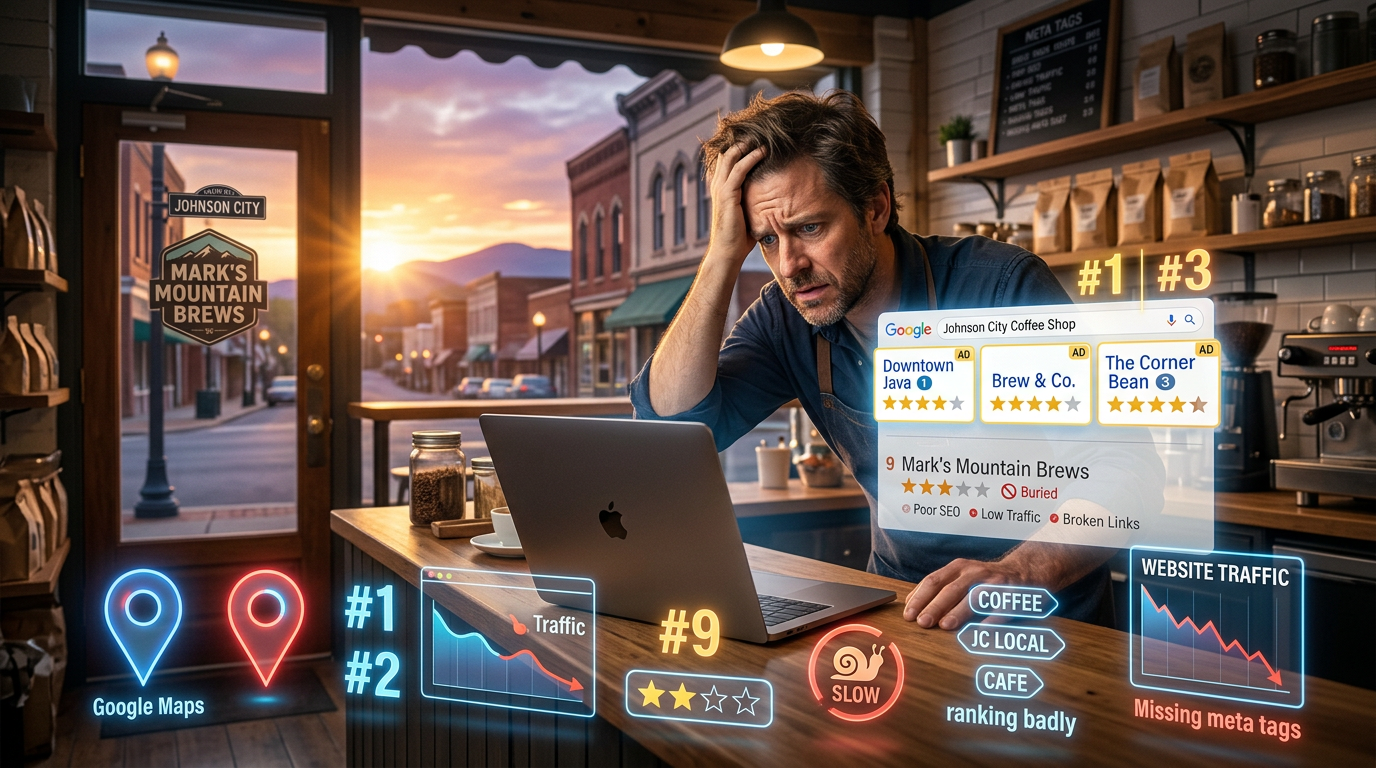
You built a real business. You show up every day. You do good work and your customers tell you so. And yet when someone in Johnson City searches for what you offer, your business is nowhere to be found.
That gap between the business you run and the business Google can find is exactly what Brent Jaworski built Main St Internet Marketing to close. Since 2009, Main St has helped local service businesses in Johnson City, the Tri-Cities, and across the country earn the kind of online visibility that produces real leads — not vanity metrics, not impressions, not rankings for terms nobody is searching. Actual calls. Actual revenue.
The reason most local businesses aren’t ranking isn’t mysterious. It comes down to seven specific, fixable problems. And understanding them starts with understanding what Google is actually trying to do.
First, Understand How Google Decides Who Ranks
When someone types “HVAC repair Johnson City” or “family dentist near me” into Google, the search engine has one job: deliver the most relevant, trustworthy, and useful result for that specific search. Google is making a recommendation on behalf of its users, and its entire business model depends on those recommendations being accurate.
To make that recommendation, Google evaluates every local business across three dimensions. Relevance: does your business match what the person is searching for? Distance: how close are you to the person searching? Prominence: how well-known, trusted, and established does your online presence appear to be?
Every ranking factor in local SEO connects back to one of those three things. When your business isn’t ranking, Google isn’t confident enough in one or more of those dimensions to recommend you over your competitors. That is the problem a certified local SEO strategy is designed to solve. It is the problem Brent Jaworski and Main St Internet Marketing have been solving for local service businesses since 2009.
Reason 1: Your Google Business Profile Is Incomplete or Neglected
If there is one single factor that determines whether you show up in the Google Map Pack — those three local listings that appear at the top of nearly every local search — it is your Google Business Profile. For most local businesses that are not ranking, this is where the problem starts.
An incomplete or neglected GBP signals to Google that your business is either not active, not legitimate, or not relevant to what people are searching for. Any one of those is enough to keep you buried. A properly optimized Google Business Profile requires complete and accurate business information across every field, the right primary category (not the most generic one — the most specific one that accurately describes your core service), individual services listed with keyword-rich descriptions, consistent posting activity, a strong and regularly updated photo presence, and active review management.
Your Google Business Profile is not a one-time setup task. It is an ongoing marketing asset. Brent Jaworski and the Main St team treat GBP optimization as a core component of every local SEO engagement, because a neglected profile is almost always a primary driver of suppressed rankings for local service businesses in Johnson City and across the Tri-Cities.
Reason 2: Your Website Has Technical Problems Google Can’t Ignore
A beautiful website and a search-engine-ready website are two completely different things. A site can look polished and professional while being technically broken from a ranking standpoint.
The most common technical issues found when auditing local business websites include slow loading speed (Google has made page speed an explicit ranking factor, and the benchmark is under 2.5 seconds — most small business websites load in five to eight), a site that is not mobile-responsive (more than 60 percent of local searches happen on a mobile device, and Google’s mobile-first indexing penalizes sites that do not adapt cleanly to a phone screen), missing or weak on-page SEO (title tags, meta descriptions, header structure, and keyword placement are the basic signals that tell Google what each page is about), no location-specific content (a service business whose website never mentions the cities it serves is going to struggle to rank for local searches in those areas regardless of how strong its other signals are), and thin or duplicate content that Google routinely ignores.
A technical SEO audit of your website is not optional. It is the foundation. Without it, every other investment in local SEO is being built on a cracked slab.
Reason 3: Your Online Citations Are Inconsistent or Incomplete
Local citations are any mention of your business name, address, and phone number across the web — directories like Yelp, Yellow Pages, Angi, BBB, and dozens of industry-specific platforms. Google uses the consistency of this information as a trust signal. When your business information appears consistently across credible sources, it validates that your business is legitimate and established. When that information is inconsistent — old addresses, different phone numbers, business name variations that do not match your GBP — it creates confusion that suppresses your rankings.
This is one of the most underestimated ranking factors in local SEO and one of the most common problems uncovered in Main St audits. A business that moved locations two years ago but never updated its citations across the web is still paying for that inconsistency today. The fix is a full citation audit, cleanup, and ongoing management — not the one-time directory submission blast that most budget SEO services provide.
Reason 4: You Don’t Have Enough Reviews — Or the Right Ones
Google reviews are one of the most powerful local ranking factors in existence. The volume of your reviews, the recency of your reviews, your average star rating, and how consistently you respond to them all feed directly into your local search rankings. The businesses that dominate the Google Map Pack in any competitive local market almost always have a systematic, ongoing approach to review generation. They are not hoping satisfied customers leave reviews. They are actively and consistently asking for them.
Volume without recency does not work — 50 reviews from three years ago carries far less weight than 15 reviews from the last 90 days. Star rating matters more than most business owners realize — the difference in click-through rate between a 4.2 and a 4.7 is significant, and people make snap judgments before they ever read a single word. Responding to every review, positive and negative, is itself a ranking signal, and most businesses get this backwards by responding to negative reviews and ignoring positive ones. A professional, calm response to a negative review often does more for your reputation than the negative review does against it.
If you have fewer than 20 reviews or your most recent review is more than 60 days old, your rankings are being affected right now.
Reason 5: You’re Targeting the Wrong Keywords
This is the reason that is hardest for business owners to see on their own, because it often looks like SEO is working when it is not. You might be ranking for keywords. They might even be relevant keywords. But if they are not the keywords your customers actually use when they are ready to hire someone, those rankings are generating zero revenue.
There is a significant difference between informational keywords and buyer-intent keywords. “How to fix a leaky faucet” is informational — the person searching it is trying to solve the problem themselves and is not looking to hire a plumber. “Plumber Johnson City TN” or “emergency plumber near me” is buyer intent — the person has a problem and is ready to call someone right now. Most automated SEO services optimize for the wrong keywords because they are easier to rank for. They produce rankings that look good in a report but generate no leads.
Real keyword strategy requires understanding your customer’s buying journey, researching how people in your specific market search for your specific services, and building content and optimization around those terms. It cannot be automated. It requires expertise and strategic thinking specific to your business and your market — exactly what eight professional certifications across search marketing, analytics, and customer acquisition are designed to produce.
Reason 6: Your Competitors Are Simply Outworking You Online
Sometimes the honest answer is this: your competitors are doing more, more consistently, and they have been doing it longer. Local SEO is not a one-time project. It is an ongoing investment in your online presence. The businesses that dominate local search in any market got there because they showed up consistently — with new content, active GBP, regular reviews, and consistent citations — month after month, year after year.
The competitive gap in local search is not fixed. It is constantly shifting. Businesses that were dominant three years ago get overtaken by competitors who invest more strategically. Businesses that start late but build correctly close the gap faster than most people expect. The key word is correctly. More activity is not the answer. More of the right activity, executed consistently by certified professionals who understand the local market, is the answer.
Reason 7: You’re Working With the Wrong SEO Partner
If you have been paying someone to handle your SEO and you are still reading this post trying to figure out why you are not ranking, this section matters most. The digital marketing industry has a serious problem with low-quality providers who sell the promise of SEO without the expertise or time investment to deliver real results. They charge low monthly fees, use automated tools to generate activity that looks like work, and report on vanity metrics that make you feel like progress is happening.
If your agency is reporting on impressions, keyword rankings for terms you do not recognize, or links built without being able to show you how any of it connects to actual leads and revenue, you are not getting what you are paying for. Real local SEO delivers measurable, documented results — leads, calls, contact form submissions, revenue. That is the standard Brent Jaworski and Main St Internet Marketing have operated by since 2009, and it is the reason clients across Johnson City, the Tri-Cities, and nationally have stayed with this agency for years.
What a Properly Executed Local SEO Strategy Actually Looks Like
A fully optimized, consistently maintained Google Business Profile with the right categories, complete service listings, regular posts, active review management, and a strong photo presence. A technically sound website that loads fast, works on mobile, has strong on-page SEO fundamentals, and contains original, location-specific content for every service you offer. Consistent, accurate citations across all major directories with ongoing monitoring for inconsistencies. An active review generation strategy producing a steady stream of recent, legitimate reviews. Keyword targeting based on actual buyer intent in your specific market. Consistent content development that builds authority over time and answers the questions your customers are actively asking. And transparent reporting on the metrics that matter — leads, calls, and conversions, not impressions and vanity rankings.
This is what real local SEO looks like. It is not complicated. But it requires expertise, consistency, and ongoing strategic attention. It is not something that happens automatically, and it is not something you get from a $99 per month automated service.
Where Does Your Business Stand Right Now?
Run this self-assessment in the next five minutes. Is every field in your Google Business Profile completely filled out? Have you posted to your GBP in the last two weeks? Do you have at least 20 reviews with an average above 4.5 stars? Have you responded to every review in the last 90 days? Does your website load in under three seconds on a mobile phone? Does every service page mention the specific cities you serve? Does each page have a unique, descriptive title tag with your target keyword? When you Google your primary service plus your city, do you appear in the Map Pack? Do you appear in the organic results below the map?
If you answered no to more than three of those, your online presence has meaningful gaps that are costing you leads right now.
The Bottom Line
Ranking on Google as a local service business is not a mystery. It is a process. And like most processes, it produces results when it is executed correctly and consistently by people who know what they are doing.
Brent Jaworski founded Main St Internet Marketing in Johnson City, Tennessee to give local service businesses access to the same caliber of certified, strategic marketing that national brands get. Eight professional certifications across search marketing, analytics, copywriting, and customer acquisition. Fifteen-plus years of navigating algorithm updates, platform changes, and the ongoing shift to AI-mediated search. Every engagement focused on one thing: measurable leads, real calls, and documented revenue growth for local service businesses in the Tri-Cities and beyond.
If you have been wondering why your business is not showing up, the answer is almost certainly in one or more of the seven areas covered in this post. Every one of them is fixable. The question is whether you have the time, expertise, and bandwidth to fix them yourself — or whether it is time to partner with someone who does this every day.
Get a Free Local Visibility Audit
We will take a comprehensive look at your Google Business Profile, your website’s technical SEO foundation, your citation consistency, your review profile, and your competitive position in local search. You will come away with a clear, honest picture of what is working, what is not, and what the path forward looks like — with no obligation and no hard sell.
Request your free Local Visibility Audit at MainStInternetMarketing.com.
Brent Jaworski is the founder and CEO of Main St Internet Marketing, a Johnson City, TN-based digital marketing agency specializing in local SEO and lead generation for service businesses across the Tri-Cities area and nationwide. He holds 8 professional certifications in search marketing, analytics, copywriting, and customer acquisition.